

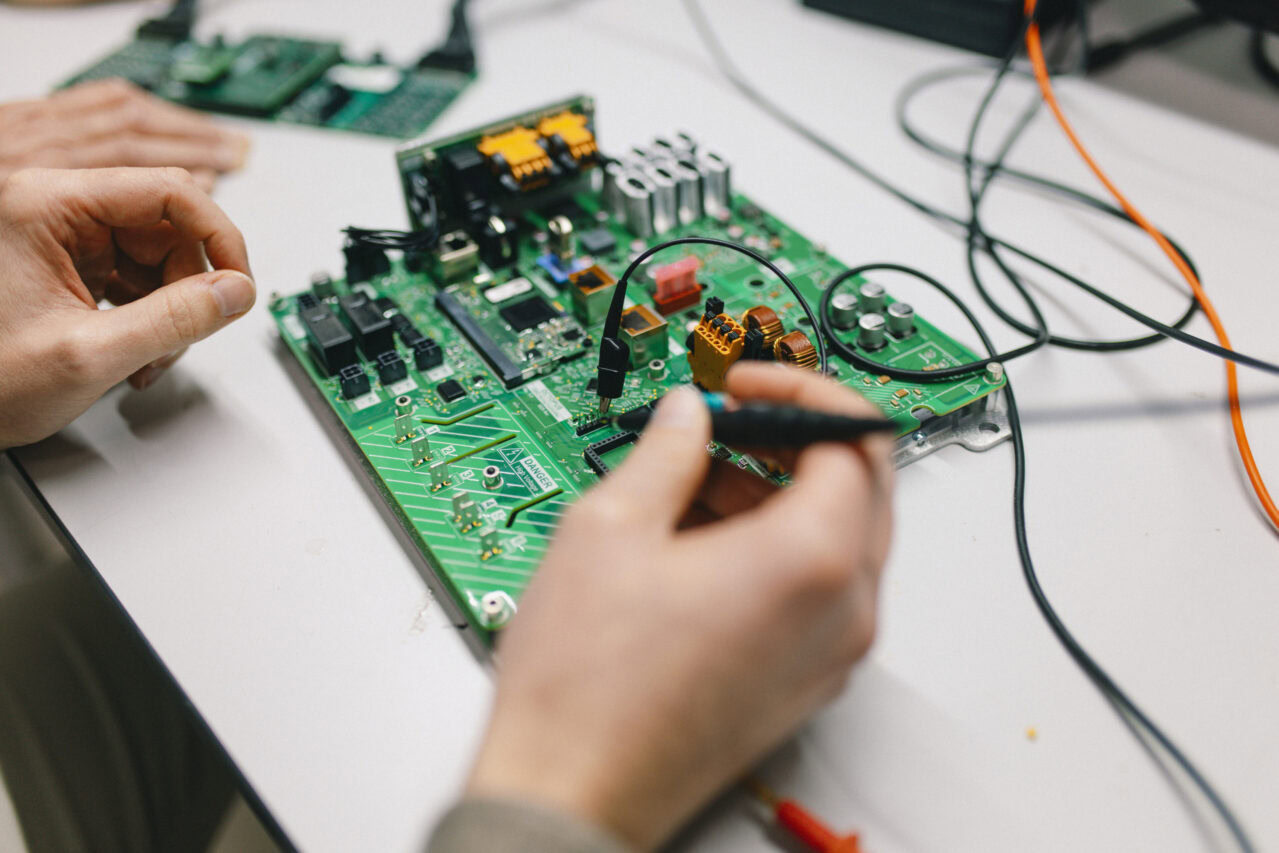
Engineering of the Octopus Platform

Full in-house development
The hardware and software developped inhouse ensure full control over the system performance, safety and lifecycle management.

+15 years of experience
Experience of BMS development troughout the years ensuring best class-approved BMS built on knowlegde from the time as System Integrator, learnings and optimizations.

European based
All our engineering activities are in our HQ in Badhoevedorp, The Netherlands, ensuring short communication-lines between departements
Battery Management System (BMS)
The Battery Management System (BMS) is the foundation of safety, performance and lifetime in every battery system. Designed and developed in-house, the BMS continuously monitors, evaluates and protects the battery at cell, module and string level, ensuring safe operation under all operating conditions.
Unlike generic battery solutions, the EST-Floattech BMS is engineered specifically for high-power maritime DC systems, where reliability, redundancy and predictable behaviour are essential.
Continuous monitoring at cell level
Each battery module contains an integrated module controller that forms part of the overall BMS. At all times, the BMS measures:
- Individual cell voltages
- Cell temperatures
- Module current
- Electrical balance between cells and modules
By monitoring every cell individually, the system maintains a detailed and accurate view of battery condition, rather than relying on averaged values.
Continuous passive cell balancing
To maximise usable capacity and extend battery lifetime, EST-Floattech applies continuous passive balancing across all cells. Small differences in cell characteristics can, over time, lead to imbalance and reduced usable energy. The BMS actively compensates for this by:
-
- By passing cells with a higher state of charge
- Keeping voltage differences between cells within a very narrow range
- Maintaining balance not only within modules, but also across the complete string
This approach ensures that the battery remains usable across its full operating window and prevents premature capacity loss.
The BMS has redundant safety features too, which you can read more about below. It is designed for long lifetime in the demanding maritime environments. but is does not operate on its own. The BMS communicates and collaborates closely with the String Controller and the System Controller. As the BMS does not directly controls the charge and discharge currents, but provides the real-time (dis)charging advice to the higher-levelled systems. This ‘collaboration’ allows propulsion drives, and converters tp regulate power flows while staying within the safe battery limits.
System Controller: the central intelligence layer
The system controller coordinaties a the complete battery system and it acts as the interface between the battery and the vessel, as it communicates directly with the vessel systems.
The system controller is responsible for:
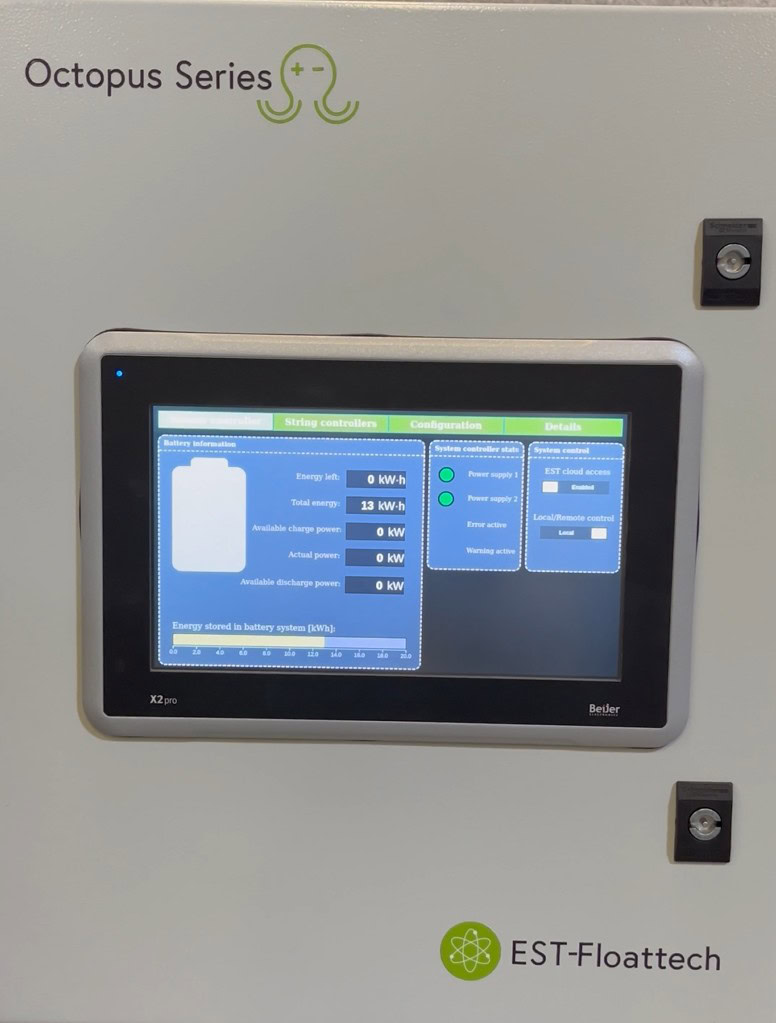
- Supervising system states (connect, disconnect, fault, recovery).
- Coordinating multiple battery strings
- Managing charging and discharging
- Exchanging operational data with external systems
- handeling alarms, warnings and automatic shutdowns
The System Controller continuously evaluates whether conditions are met for safe operation before allowing any string to connect to the DC bus. It ensures control and safety logic on system-level. But, most importantly, thanks to the system controller the battery system behaves predictably under all operational conditions, including possible abnormal or emergency scenarios.

Active protection: advanced alarms and warning logics
The BMS continuously monitors parameters at cell, module, string and system level. Alarms and warnings are categorised and aggregated to give a clear system overview.
Typical monitored conditions include:
- Voltage and current limits
- Cell and module temperature
- Communication integrity
- Contactor state verification
- Precharge and ramp-up timing
- Common mode voltage behaviour
Protective actions — such as limiting power or disconnecting strings — can be triggered automatically when thresholds are exceeded.
Emergency stop and fail-safe design
Safety does not rely on software alone. The EST-Floattech BMS includes a hardware-based fail-safe circuit that operates independently from software and communication layers.
If critical conditions are detected or in the unlikely case the control software becomes unresponsive the fail-safe circuit will immediately disconnect the battery string from the DC bus, placing the system in a safe state.
This layered approach ensures safety even in extreme or unexpected scenarios.
- Emergency stop can be wired across multiple strings
- Triggering one emergency stop can safely bring the entire system to a defined safe state
- Configuration can be adapted to vessel or class requirements (normally open / normally closed)
- Hardware-level logic remains active even if software is not responding
This layered approach ensures predictable behaviour under all circumstances.
Contact us
We are happy to answer your questions
Do you want to know more about the Octopus Series or are you interested in advice for your battery system? Or if you don’t have a specific question yet, but want to get in touch, fill in the contactform.