
Inland shipping is at a crossroads. With various requirements for emissions, zero-emission zones and customer expectations that are forcing the sector to accelerate. Among others, the Dutch government recognizes this and wants to give it a push in the right direction with subsidies under the heading of Energy Transition Inland Shipping, expected to amount to more than 200 million euros between 2026 and 2030, including for electrification.
At EST-Floattech, we have believed in completely emission-free inland shipping for years now. With more than 100 ships that have our battery systems on board, they are already sailing on European inland waterways.
Inland shipping? Always ES-TRIN
For ships sailing on European inland waters that do not have a specific certificate, the European Inland Waterways Regulation (ES-TRIN) applies. ES-TRIN explicitly refers to two international standards for lithium-ion battery systems:
IEC 62619 – safety requirements for industrial lithium-ion batteries
IEC 62620 – performance and characterization criteria (performance, markings, etc.)
Together, these standards form the basis for the safe use of battery systems on board. Whereas the emphasis used to be on functional testing (e.g., does the system shut down in the event of a fault?), qualifications at the design level of the battery system have now been added. For example, cell voltages are measured via a primary channel and an independent safety channel. Each component is assessed, calculated, and recorded. Based on this, SIL levels (Safety Integrity Levels) are determined, which objectively demonstrate that the design achieves a high level of safety.
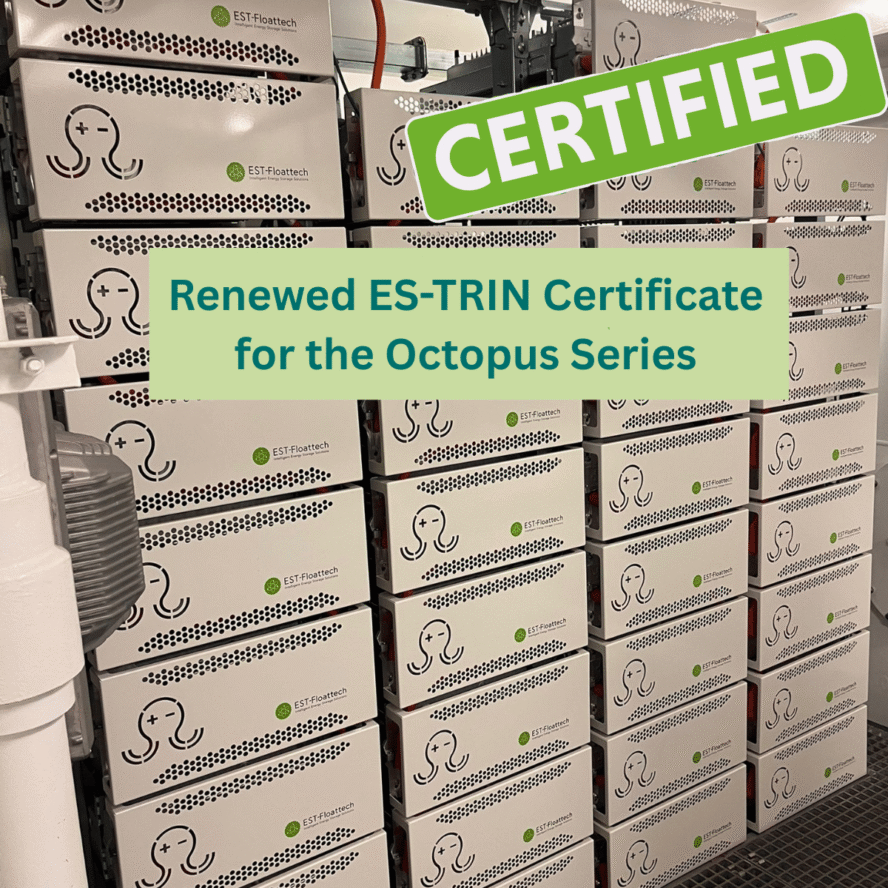
EST-Floattech was already certified before these stricter requirements came into force. At that time, the emphasis was mainly on functional testing. With the new IEC requirements, the bar has been raised. That is why we have engaged an independent research institute to carry out the risk assessment and draw up the complete design evidence in accordance with the IEC 62619 and 62620 requirements and SIL methodology. We are therefore proud to announce that, in addition to the official tests according to ES-TRIN, our battery systems now also comply with the revised international IEC standards 62619 and 62620.
For us, this is further confirmation that our “Safe by design” mentality works and that we can guarantee safety and performance on board.
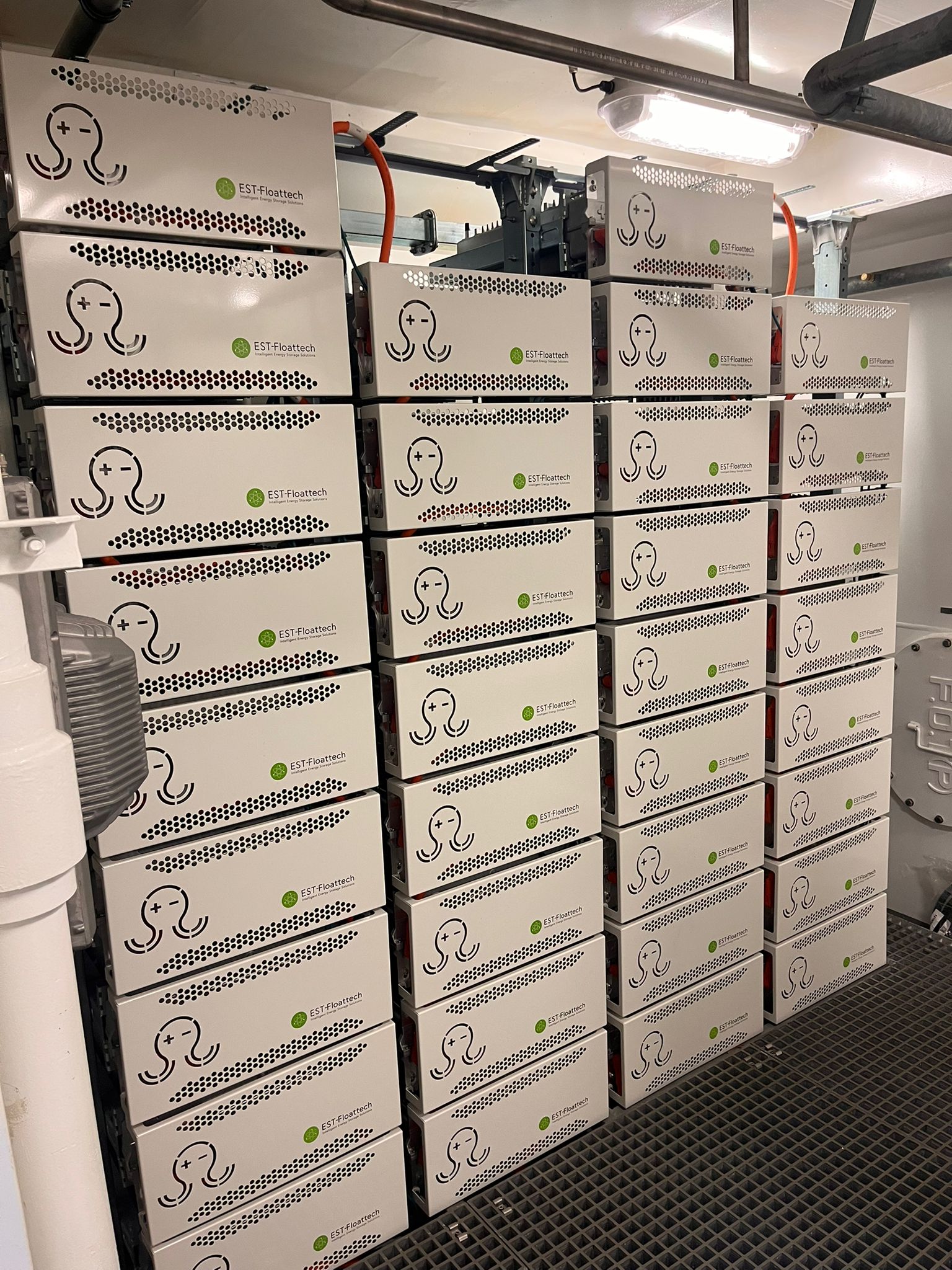
Battery systems for inland waterway vessels
The Octopus Series offers a wide range of solutions, from high-energy and high-power NMC modules to LFP modules, active or passive cooling, and various capacities and configurations. As the basis for our customized solutions we recommend a combination of the various options: a thorough analysis of your sailing profile and discussions about what you need now or in the future. With the flexibility of the system and the knowledge of our team, we can design a suitable system for virtually any sailing profile and battery space. We support you from design to integration.
The Battery Management System (BMS) that is integrated into all Octopus systems was developed entirely in the Netherlands. The battery system is also manufactured in the Netherlands, and the service team is based there too. Updates and modifications can be implemented quickly, and support is available almost immediately. This means that systems are always up to date. It shortens lead times, increases reliability, and reduces dependence on external parties.
With EST-Floattech, you are not alone; you have a sparring partner who supports you throughout the process. Through scalability, in-depth system knowledge, and long-term support, we help our customers to ensure operational continuity and easily integration with future developments.
“The technology is there. The regulations are there. The subsidies are there. Anyone who does not opt for emission-free sailing now will soon be lagging behind.”
Diederick Stam, Founder and CTO
NMC or LFP? Why battery chemistry is a strategic choice for ships
In maritime applications, NMC (Nickel Manganese Cobalt) and LFP (Lithium Iron Phosphate) are the most commonly used lithium-ion chemistries. Both have clear advantages, but their suitability varies greatly depending on the vessel and operational profile. EST-Floattech has also developed an LFP module that runs on the proven and trusted BMS. If you would like to know more about LFP and NMC, read the white paper.
With the renewed ES-TRIN certificate and fast delivery times, your ship can quickly be made sustainable with the Octopus Series: a robust, safe and reliable battery system that is suitable for different battery compartments thanks to its modular design.